
Elk Grove Village Address Eras
No single source spans the full life of an Elk Grove Village address. Begin with the newest parcel and deed, then cross each owner period with a dated household source. The county split matters at every step.
| Source | Years covered | Where held | What it shows |
|---|---|---|---|
| Cook recorded instruments | Online search described from 1985 | Cook County Clerk recordings, terminal, staff, paper files | Deed parties, dates, document numbers, legal descriptions |
| DuPage recorded instruments | Indexed images from March 16, 1961 | DuPage Recorder web search and public terminals | Grantor, grantee, type, date, PIN, image |
| Parcel and tax records | Current and portal-specific history | Cook Assessor/property information or DuPage Property Lookup | PIN, parcel facts, labeled owner or billing relationship, transfer clues |
| Local newspaper archive | 1995 through 2004 | Elk Grove Village Public Library, in library | Dated notices, obituaries, organizations, events |
| Federal census | Released schedules through 1950 | National Archives and library databases | Households and relationships in census context |
| Village public files | Post-incorporation, file dependent | Accela, WebLink, Clerk, Community Development | Permits, plats, annexations, hearings, public roles |
The exact local run of printed city or reverse directories was not published on the inspected library pages. Ask for a catalog record and year before assigning a listing to a past resident.
Start Elk Grove Village Address History
Normalize the present address first. Save the number, direction, unit, street spelling, ZIP, county, and date checked. The Cook County Assessor and CookViewer cover Cook parcels. The DuPage Property Lookup and DuPage GIS cover the small western part of the Village.
Copy the PIN and legal description. A PIN identifies a parcel, not a person. On Cook cards, “Property Location” is not guaranteed to be a postal or legal mailing address. On DuPage cards, owner and billing fields appear with transfer, tax, map, and legal tabs. Preserve the portal’s labels. They are starting clues, not proof of previous residents.
Research key. Record the county and PIN before copying a name, since the wrong county can produce a convincing but unrelated result.
Trace Elk Grove Village Deeds Backward
The chain of title is the ordered series of recorded interests in a parcel. It follows legal ownership, not every household. Start with the current parcel card and latest transfer, then use the matching county recorder.
- Find the newest purchase deed and save its document number, recording date, deed type, grantor, grantee, and legal description.
- Search the seller’s name as a prior grantee. Narrow by date, PIN, subdivision, or document group where the portal permits it.
- Open the earlier purchase deed and confirm that its legal description matches the same land.
- Repeat the seller-to-prior-purchase link. Keep mortgages, releases, liens, easements, plats, and annexation papers in separate rows.
- At the online cutoff, move to a public terminal, paper index, staff request, archives, or certified-copy route.
- Grantor
- The party transferring a recorded interest.
- Grantee
- The party receiving that interest.
- Chain of title
- The linked sequence of recorded transfers for the same land.
- Legal description
- The formal land description that can remain useful when an address changes.
The DuPage Recorder search accepts names, street fields, PIN segments, subdivision or business names, document numbers, groups, and date ranges. Cook’s live CRS result was blocked during research, so use the Cook Clerk recordings gateway or the public terminal when the online route fails.
Past Residents Beyond Online Cutoffs
Online silence is not proof that no deed exists. Cook performance material describes web search and retrieval from 1985 forward. DuPage’s indexed document and image coverage begins March 16, 1961. Older instruments may remain in deed books, paper indexes, microfilm, or archive holdings.
Cook recording staff can be reached through the Clerk recordings division, including the public counter at 118 North Clark Street in Chicago, phone 312-603-5050, and clerk.recordings@cookcountyil.gov. DuPage Recorder staff work at 421 North County Farm Road in Wheaton, with the main line at 630-407-5400 and research line at 630-407-5401. Ask for the current pre-cutoff procedure and any copy charge before sending payment.
This contrast is a useful local rule. DuPage exposes a detailed public form, while Cook’s current direct result could not be captured. A reliable previous residents search keeps both online and counter routes available.
Note: Index coverage dates describe the web tool, not the first surviving land record for either county.
Pair Elk Grove Village Household Sources
Deeds identify recorded interests. To research who lived here before, pair each ownership span with a dated directory, census schedule, newspaper, permit, obituary, or probate file. The library has verified genealogy and public-record database pages, but it did not publish an exact local city-directory, reverse-directory, Sanborn map, or obituary-index run in the inspected material.
- Ask library staff which address-indexed or surname-indexed volume covers the target year and place name.
- Search the address, street, surname, spouse or maiden variant, subdivision, and nearby place names.
- For census years, search Elk Grove Township and both counties as well as the modern Village name.
- Compare the directory publication date with the census date, deed date, and parcel identity. Do not merge same-name entries without another matching detail.
- Cite the title, year, page or image, access location, and date checked.
The historical collections themselves are described on the Elk Grove Village city directory page. This backward-address method uses them only after the parcel and time period are fixed.
Library Clues for Past Residents
The Elk Grove Village Public Library is the local research node. Its Elk Grove Times archive covers 1995 through 2004 in full-text PDFs, but access is in library only. That limitation makes a reference request part of the real workflow. Ask staff to check an exact address, street, surname, subdivision, obituary, public notice, or organization, then preserve the newspaper date and page.
HeritageQuest and other library genealogy databases can connect census, directory, and family-history evidence. The Illinois State Archives is the backup when a household predates incorporation or appears under township or county labels. No dedicated public house-history guide was found for the library, so describe the request as a reference question rather than promising a named service.
A city directory or newspaper address is evidence for its publication date. It does not prove that the household stayed for the whole year.
Annexations Changed Elk Grove Village Searches
Elk Grove Village incorporated in 1956 and grew through more than 150 annexations. A modern parcel may once have been described under Elk Grove Township, Cook County, DuPage County, O’Hare, Orchard Place, or a nearby community. Plats and annexation ordinances may connect the old legal description to the current parcel.
No official street-renumbering year, E911 address archive, or dedicated address-change index was located. Do not assume a stable street name means a stable house number. Compare the Village annexation map, county GIS, recorded plat, legal description, newspaper date, and directory year. If the crosswalk remains unclear, ask Village Community Development or Engineering for an existing address-history, plat, or annexation file.
This planned-community history is not just local color. It explains why previous residents can vanish when only the modern Elk Grove Village label is searched.
Close Elk Grove Village Resident Trails
Obituaries, probate files, cemetery records, and vital records can close a household trail after a person leaves the address or dies. Treat each as a separate evidence class. An obituary reports family links as published. Probate may identify heirs, petitions, orders, wills, or estate property. Cemetery monuments and registers provide burial context, not a household roster.
The Illinois death-record route explains statewide ordering and access. The captured official screen is included because the manifest marks it successful.
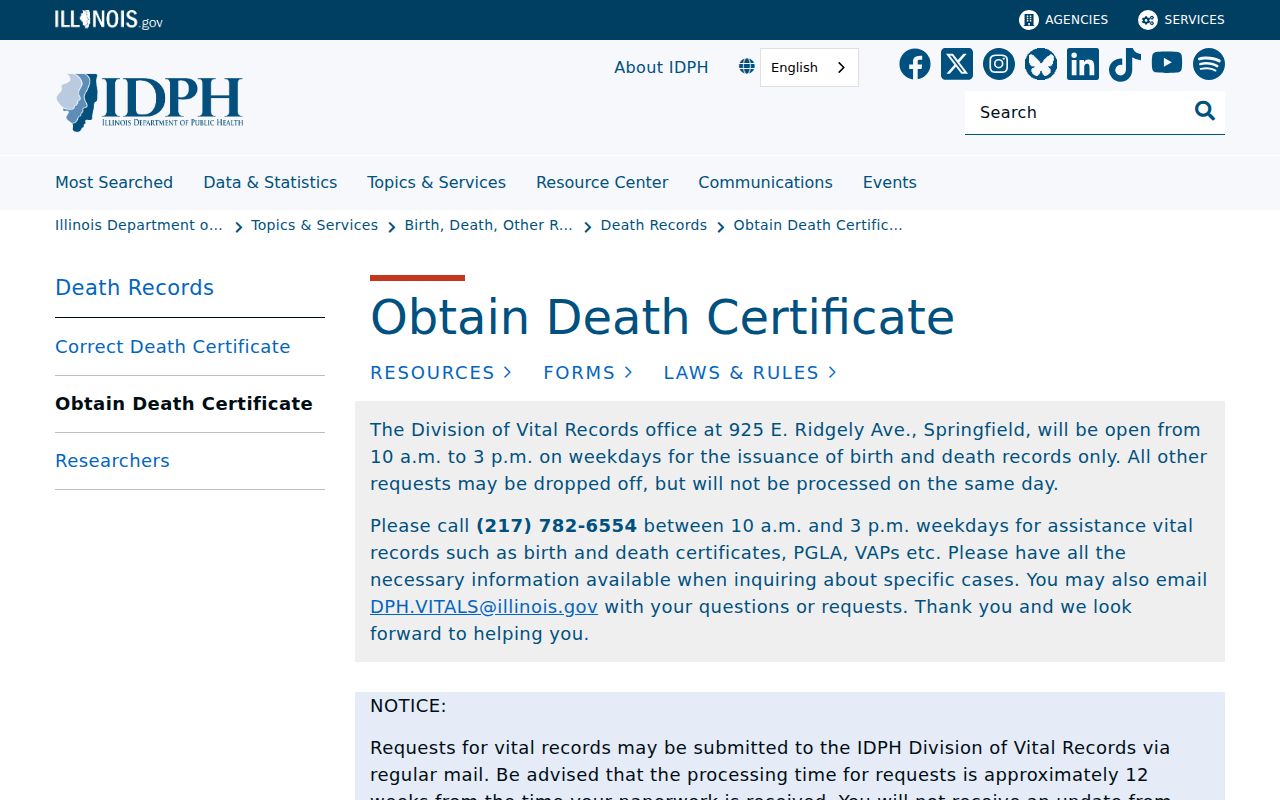
The state page leads to a formal record request, not an open directory of deaths.
Illinois inspection and genealogy rules depend on record type, age, relationship, identity, and requested copy. Cook and DuPage also have county routes for events they hold. Use a probate docket or obituary to narrow an event before ordering a record.
Elk Grove Cemetery’s Boundary Story
Elk Grove Cemetery sits outside the incorporated Village in unincorporated Elk Grove Township, yet Village records discuss it because the Village plows the site under an intergovernmental agreement. That boundary quirk shows why a previous residents search must not equate “Elk Grove” with the current municipal line.
A cemetery board or the Elk Grove Historical Society may help explain registers, monuments, family plots, or older place names. The 2026 Village anniversary program also includes cemetery restoration and rededication work. Cite those modern notices as project records, then verify any burial claim with the cemetery or a dated historical source.
Use Elk Grove Village History Lawfully
Previous residents research supports genealogy, house history, estate work, reunion projects, and civic history. It does not justify guessing where a living person is now. Protected addresses, private utility details, sealed files, and restricted vital records remain outside a public address trail.
Keep only the facts needed for the research question. Label uncertain links, distinguish owners from occupants, and correct a timeline when the custodian supplies a better record. A missing year should remain a gap rather than an invented household.
Lawful use. Never use past resident records to stalk, harass, threaten, or expose a living person or a protected address.